

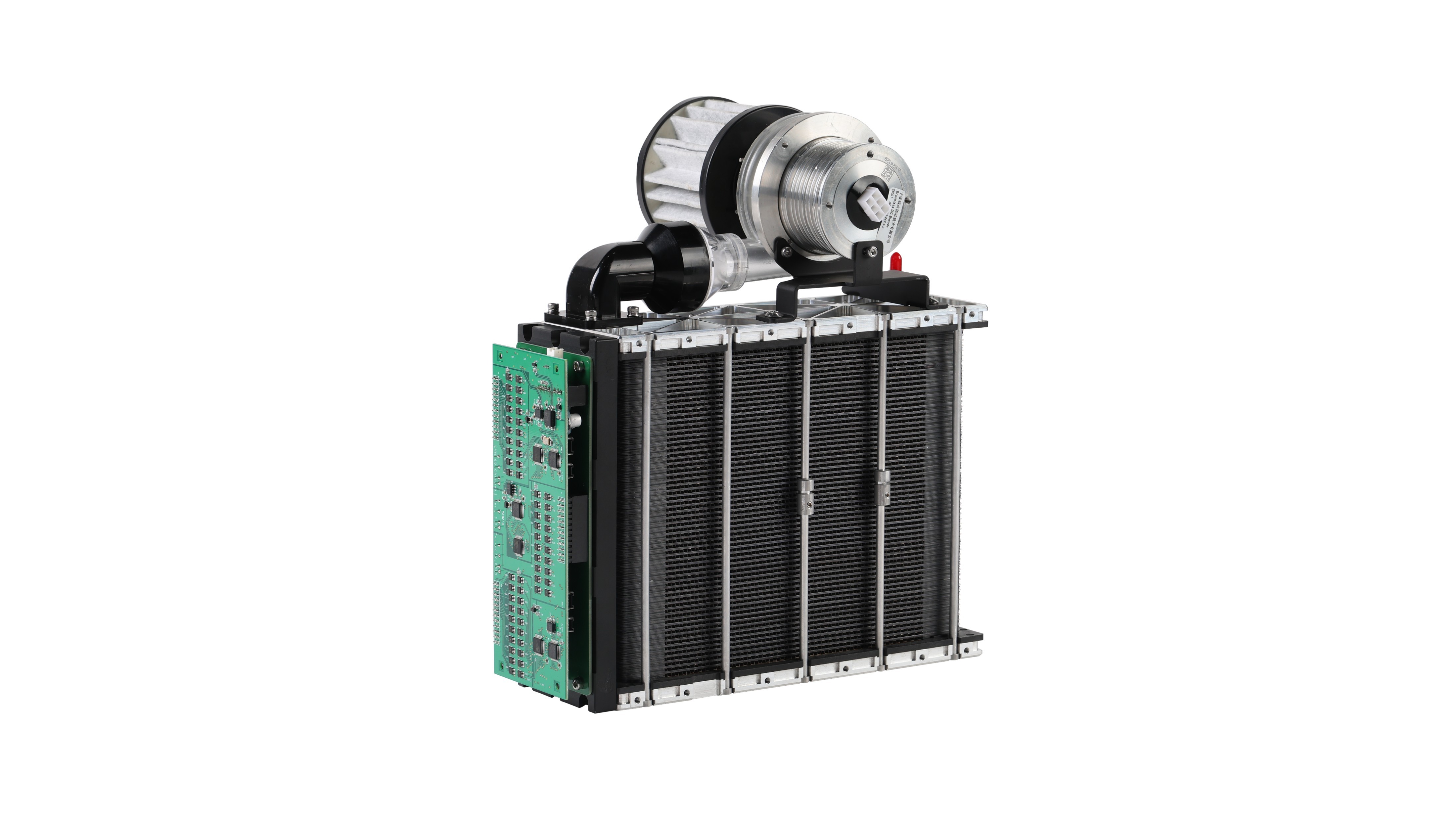
TerraLIX has demonstrated outstanding long-term storage durability of its proprietary closed-cathode air-cooled hydrogen fuel cell stack platform, confirming stable power performance even after more than 40 months of storage.
Conventional open-cathode air-cooled fuel cells have historically faced critical long-term storage limitations due to direct exposure of the cathode electrode to ambient air. Over extended idle periods, membrane dehydration and platinum surface oxidation can occur, often leading to significant performance degradation upon restart.
In contrast, TerraLIX’s closed-cathode architecture minimizes external air ingress and moisture loss during non-operating conditions, creating a protected internal environment that preserves stack integrity over extended storage durations.
TerraLIX has demonstrated outstanding long-term storage durability of its proprietary closed-cathode air-cooled hydrogen fuel cell stack platform, confirming stable power performance even after more than 40 months of storage.
Conventional open-cathode air-cooled fuel cells have historically faced critical long-term storage limitations due to direct exposure of the cathode electrode to ambient air. Over extended idle periods, membrane dehydration and platinum surface oxidation can occur, often leading to significant performance degradation upon restart.
In contrast, TerraLIX’s closed-cathode architecture minimizes external air ingress and moisture loss during non-operating conditions, creating a protected internal environment that preserves stack integrity over extended storage durations.
TerraLIX has demonstrated outstanding long-term storage durability of its proprietary closed-cathode air-cooled hydrogen fuel cell stack platform, confirming stable power performance even after more than 40 months of storage.
Conventional open-cathode air-cooled fuel cells have historically faced critical long-term storage limitations due to direct exposure of the cathode electrode to ambient air. Over extended idle periods, membrane dehydration and platinum surface oxidation can occur, often leading to significant performance degradation upon restart.
In contrast, TerraLIX’s closed-cathode architecture minimizes external air ingress and moisture loss during non-operating conditions, creating a protected internal environment that preserves stack integrity over extended storage durations.
TerraLIX conducted a long-term storage evaluation on its air-cooled stack platform after approximately 40 months of non-operational storage.
The evaluation confirmed that the stack maintained highly stable output characteristics after restart, with only a 2.58% voltage reduction observed compared to the initial reference performance.
The test results demonstrated continuous and stable operation under the following conditions:
Hydrogen: 99.9%
Inlet Pressure: 0.8 barg
Cathode: Blower, No Humidifier
Stack Temperature: 47–49°C
Stack Current: 32.5 A (500 mA/cm²)
Despite the extended storage duration, the stack successfully achieved stable power generation in the 1.02–1.05 kW range without abnormal voltage instability or operational failure.
TerraLIX conducted a long-term storage evaluation on its air-cooled stack platform after approximately 40 months of non-operational storage.
The evaluation confirmed that the stack maintained highly stable output characteristics after restart, with only a 2.58% voltage reduction observed compared to the initial reference performance.
The test results demonstrated continuous and stable operation under the following conditions:
Hydrogen: 99.9%
Inlet Pressure: 0.8 barg
Cathode: Blower, No Humidifier
Stack Temperature: 47–49°C
Stack Current: 32.5 A (500 mA/cm²)
Despite the extended storage duration, the stack successfully achieved stable power generation in the 1.02–1.05 kW range without abnormal voltage instability or operational failure.
TerraLIX conducted a long-term storage evaluation on its air-cooled stack platform after approximately 40 months of non-operational storage.
The evaluation confirmed that the stack maintained highly stable output characteristics after restart, with only a 2.58% voltage reduction observed compared to the initial reference performance.
The test results demonstrated continuous and stable operation under the following conditions:
Hydrogen: 99.9%
Inlet Pressure: 0.8 barg
Cathode: Blower, No Humidifier
Stack Temperature: 47–49°C
Stack Current: 32.5 A (500 mA/cm²)
Despite the extended storage duration, the stack successfully achieved stable power generation in the 1.02–1.05 kW range without abnormal voltage instability or operational failure.
For hydrogen fuel cell systems deployed in defense, aerospace, emergency backup power, and unmanned systems, long-term storage capability is a critical reliability requirement.
Many conventional air-cooled stacks experience severe restart degradation after prolonged idle periods due to:
Membrane drying
Catalyst surface oxidation
Oxygen exposure
Internal corrosion mechanisms
These degradation mechanisms can reduce output performance, shorten operational lifetime, and create uncertainty during mission-critical deployment.
TerraLIX’s closed-cathode technology structurally addresses these limitations by maintaining an internally protected stack environment during shutdown and storage periods.
For hydrogen fuel cell systems deployed in defense, aerospace, emergency backup power, and unmanned systems, long-term storage capability is a critical reliability requirement.
Many conventional air-cooled stacks experience severe restart degradation after prolonged idle periods due to:
Membrane drying
Catalyst surface oxidation
Oxygen exposure
Internal corrosion mechanisms
These degradation mechanisms can reduce output performance, shorten operational lifetime, and create uncertainty during mission-critical deployment.
TerraLIX’s closed-cathode technology structurally addresses these limitations by maintaining an internally protected stack environment during shutdown and storage periods.
For hydrogen fuel cell systems deployed in defense, aerospace, emergency backup power, and unmanned systems, long-term storage capability is a critical reliability requirement.
Many conventional air-cooled stacks experience severe restart degradation after prolonged idle periods due to:
Membrane drying
Catalyst surface oxidation
Oxygen exposure
Internal corrosion mechanisms
These degradation mechanisms can reduce output performance, shorten operational lifetime, and create uncertainty during mission-critical deployment.
TerraLIX’s closed-cathode technology structurally addresses these limitations by maintaining an internally protected stack environment during shutdown and storage periods.
The key differentiator of TerraLIX’s stack platform is its proprietary closed-cathode air management architecture.
Unlike open-cathode systems where the cathode is continuously exposed to ambient air, the TerraLIX design minimizes unnecessary external air exchange when the system is inactive. This approach helps suppress:
Membrane dehydration
Platinum catalyst oxidation
Moisture imbalance
External contamination ingress
As a result, the stack maintains stable electrochemical conditions even during extended storage periods.
This design philosophy significantly enhances reliability for field-deployed systems requiring infrequent but immediate operation readiness.
The key differentiator of TerraLIX’s stack platform is its proprietary closed-cathode air management architecture.
Unlike open-cathode systems where the cathode is continuously exposed to ambient air, the TerraLIX design minimizes unnecessary external air exchange when the system is inactive. This approach helps suppress:
Membrane dehydration
Platinum catalyst oxidation
Moisture imbalance
External contamination ingress
As a result, the stack maintains stable electrochemical conditions even during extended storage periods.
This design philosophy significantly enhances reliability for field-deployed systems requiring infrequent but immediate operation readiness.
The key differentiator of TerraLIX’s stack platform is its proprietary closed-cathode air management architecture.
Unlike open-cathode systems where the cathode is continuously exposed to ambient air, the TerraLIX design minimizes unnecessary external air exchange when the system is inactive. This approach helps suppress:
Membrane dehydration
Platinum catalyst oxidation
Moisture imbalance
External contamination ingress
As a result, the stack maintains stable electrochemical conditions even during extended storage periods.
This design philosophy significantly enhances reliability for field-deployed systems requiring infrequent but immediate operation readiness.
The long-term storage verification further reinforces TerraLIX’s position as a developer of high-reliability closed-cathode air-cooled hydrogen fuel cell platforms engineered for demanding operating environments.
Combined with previously demonstrated capabilities including:
Stable operation at –35°C extreme cold conditions
Humidifier-free operation
Lightweight titanium bipolar plate architecture
High power density air-cooled stack technology
TerraLIX continues to advance next-generation hydrogen fuel cell systems optimized for aerospace, defense, mobility, and distributed power applications where durability and operational readiness are essential.
The long-term storage verification further reinforces TerraLIX’s position as a developer of high-reliability closed-cathode air-cooled hydrogen fuel cell platforms engineered for demanding operating environments.
Combined with previously demonstrated capabilities including:
Stable operation at –35°C extreme cold conditions
Humidifier-free operation
Lightweight titanium bipolar plate architecture
High power density air-cooled stack technology
TerraLIX continues to advance next-generation hydrogen fuel cell systems optimized for aerospace, defense, mobility, and distributed power applications where durability and operational readiness are essential.
The long-term storage verification further reinforces TerraLIX’s position as a developer of high-reliability closed-cathode air-cooled hydrogen fuel cell platforms engineered for demanding operating environments.
Combined with previously demonstrated capabilities including:
Stable operation at –35°C extreme cold conditions
Humidifier-free operation
Lightweight titanium bipolar plate architecture
High power density air-cooled stack technology
TerraLIX continues to advance next-generation hydrogen fuel cell systems optimized for aerospace, defense, mobility, and distributed power applications where durability and operational readiness are essential.

CEO
Tae-Young Kim
support@terralix.com
Tel.
+82-63-581-1633
Fax.
+82-63-581-1639
Address
56332) 28, Sinjaesaengeneoji-ro, Haseo-myeon,
Buan-gun, Jeollabuk-do, Republic of Korea
TerraLIX Co., LTD
CEO
Tae-Young Kim
support@terralix.com
Tel.
+82-63-581-1633
Fax.
+82-63-581-1639
Address
56332) 28, Sinjaesaengeneoji-ro, Haseo-myeon, Buan-gun, Jeollabuk-do, Republic of Korea
TerraLIX Co., LTD
CEO
Tae-Young Kim
support@terralix.com
Tel.
+82-63-581-1633
Fax.
+82-63-581-1639
Address
56332) 28, Sinjaesaengeneoji-ro, Haseo-myeon, Buan-gun, Jeollabuk-do, Republic of Korea
TerraLIX Co., LTD