

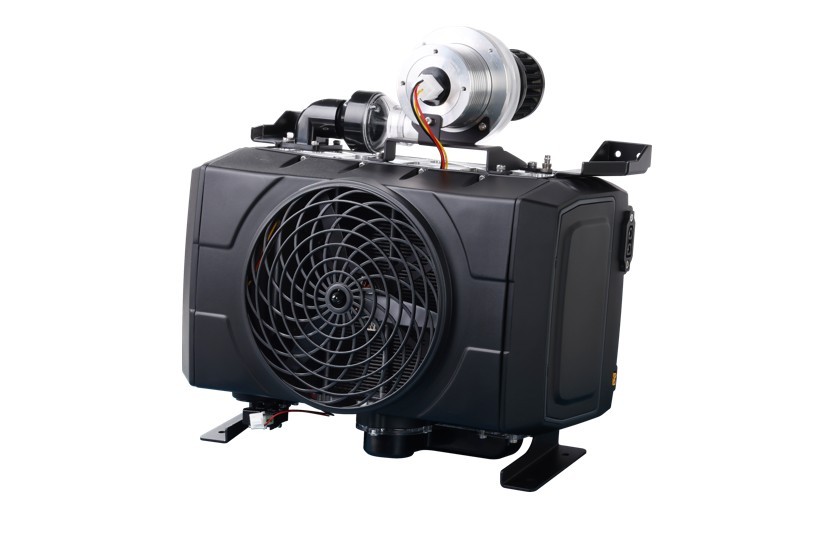
TerraLIX announced that it has successfully developed the air-cooled hydrogen fuel cell capable of stable operation in extreme cold environments down to –35 °C.
Hydrogen fuel cells have attracted growing attention as an alternative power source for long-endurance drones (UAVs) due to their high energy density and ability to deliver continuous power over extended periods. However, conventional air-cooled fuel cells have faced critical limitations in sub-zero conditions, where freezing of generated water restricts oxygen supply within the catalyst layer, leading to unstable operation and reduced output.
TerraLIX announced that it has successfully developed the air-cooled hydrogen fuel cell capable of stable operation in extreme cold environments down to –35 °C.
Hydrogen fuel cells have attracted growing attention as an alternative power source for long-endurance drones (UAVs) due to their high energy density and ability to deliver continuous power over extended periods. However, conventional air-cooled fuel cells have faced critical limitations in sub-zero conditions, where freezing of generated water restricts oxygen supply within the catalyst layer, leading to unstable operation and reduced output.
TerraLIX announced that it has successfully developed the air-cooled hydrogen fuel cell capable of stable operation in extreme cold environments down to –35 °C.
Hydrogen fuel cells have attracted growing attention as an alternative power source for long-endurance drones (UAVs) due to their high energy density and ability to deliver continuous power over extended periods. However, conventional air-cooled fuel cells have faced critical limitations in sub-zero conditions, where freezing of generated water restricts oxygen supply within the catalyst layer, leading to unstable operation and reduced output.
To address these challenges, TerraLIX introduced a closed-cathode architecture capable of operation without external humidification, combined with its proprietary thermal circulation technology. This integrated design enables the fuel cell to maintain thermal balance using only internally generated heat, without relying on auxiliary heaters or external heat sources.
As a result, TerraLIX has achieved stable start-up and continuous operation at –35 °C, establishing a new global benchmark for air-cooled hydrogen fuel cell technology. The solution structurally resolves long-standing issues such as membrane drying, ice formation from product water, and oxygen starvation under extreme cold conditions.
To address these challenges, TerraLIX introduced a closed-cathode architecture capable of operation without external humidification, combined with its proprietary thermal circulation technology. This integrated design enables the fuel cell to maintain thermal balance using only internally generated heat, without relying on auxiliary heaters or external heat sources.
As a result, TerraLIX has achieved stable start-up and continuous operation at –35 °C, establishing a new global benchmark for air-cooled hydrogen fuel cell technology. The solution structurally resolves long-standing issues such as membrane drying, ice formation from product water, and oxygen starvation under extreme cold conditions.
To address these challenges, TerraLIX introduced a closed-cathode architecture capable of operation without external humidification, combined with its proprietary thermal circulation technology. This integrated design enables the fuel cell to maintain thermal balance using only internally generated heat, without relying on auxiliary heaters or external heat sources.
As a result, TerraLIX has achieved stable start-up and continuous operation at –35 °C, establishing a new global benchmark for air-cooled hydrogen fuel cell technology. The solution structurally resolves long-standing issues such as membrane drying, ice formation from product water, and oxygen starvation under extreme cold conditions.
This breakthrough fundamentally overcomes the structural limitations of conventional air-cooled fuel cells and is expected to open new opportunities in defense and unmanned systems. Potential applications include surveillance and reconnaissance drones, long-endurance UAVs, and military equipment operating in harsh and cold environments.
Compared to battery-based power systems, TerraLIX’s air-cooled hydrogen fuel cell offers superior low-temperature performance, extended operating duration, and enhanced safety, making it a highly reliable power solution for mission-critical applications.
Building on this achievement, TerraLIX plans to further advance its extreme-environment air-cooled fuel cell platform and expand its global presence across the defense, aerospace, and advanced mobility sectors.
This breakthrough fundamentally overcomes the structural limitations of conventional air-cooled fuel cells and is expected to open new opportunities in defense and unmanned systems. Potential applications include surveillance and reconnaissance drones, long-endurance UAVs, and military equipment operating in harsh and cold environments.
Compared to battery-based power systems, TerraLIX’s air-cooled hydrogen fuel cell offers superior low-temperature performance, extended operating duration, and enhanced safety, making it a highly reliable power solution for mission-critical applications.
Building on this achievement, TerraLIX plans to further advance its extreme-environment air-cooled fuel cell platform and expand its global presence across the defense, aerospace, and advanced mobility sectors.
This breakthrough fundamentally overcomes the structural limitations of conventional air-cooled fuel cells and is expected to open new opportunities in defense and unmanned systems. Potential applications include surveillance and reconnaissance drones, long-endurance UAVs, and military equipment operating in harsh and cold environments.
Compared to battery-based power systems, TerraLIX’s air-cooled hydrogen fuel cell offers superior low-temperature performance, extended operating duration, and enhanced safety, making it a highly reliable power solution for mission-critical applications.
Building on this achievement, TerraLIX plans to further advance its extreme-environment air-cooled fuel cell platform and expand its global presence across the defense, aerospace, and advanced mobility sectors.

CEO
Tae-Young Kim
support@terralix.com
Tel.
+82-63-581-1633
Fax.
+82-63-581-1639
Address
56332) 28, Sinjaesaengeneoji-ro, Haseo-myeon,
Buan-gun, Jeollabuk-do, Republic of Korea
TerraLIX Co., LTD
CEO
Tae-Young Kim
support@terralix.com
Tel.
+82-63-581-1633
Fax.
+82-63-581-1639
Address
56332) 28, Sinjaesaengeneoji-ro, Haseo-myeon, Buan-gun, Jeollabuk-do, Republic of Korea
TerraLIX Co., LTD
CEO
Tae-Young Kim
support@terralix.com
Tel.
+82-63-581-1633
Fax.
+82-63-581-1639
Address
56332) 28, Sinjaesaengeneoji-ro, Haseo-myeon, Buan-gun, Jeollabuk-do, Republic of Korea
TerraLIX Co., LTD